
A Swiss-engineered solution for deep geothermal energy 

Deep Rock Mechanics

A Master’s thesis by Vilde Jensen exploring how long-term heat extraction affects the mechanical stability of deep granitic rock, helping build the knowledge required to engineer reliable deep geothermal systems.

Executive Summary

What happened

Simulating thermal stresses at 5 km depth.

Why it matters

Understanding rock behavior for safe, long-term heat extraction.

Reading Time

~1 min

Understanding Rock Behavior at Depth

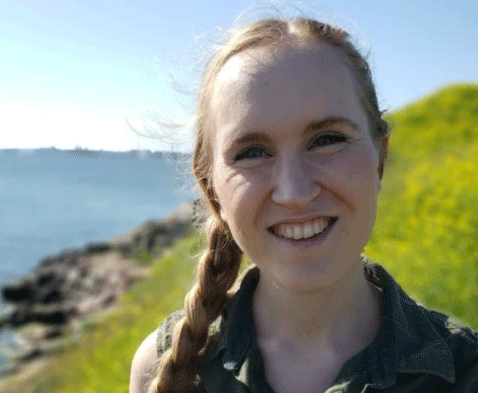
In 2020, Vilde Jensen, MSc student at Oulu Mining School, investigated the effect of cooling on the mechanical behavior of granitic rocks at 5 km depth using numerical simulations.

Designing for Long-Term Heat Extraction

The research explored how thermal stresses generated during continuous heat extraction can affect rock stability and deep-well integrity, an important consideration for the long-term operation of deep geothermal systems.

An Outstanding Academic Achievement

The work was hosted by AFRY Finland, with financial support from the Bern Economic Development Agency. Vilde defended her Master’s thesis in November 2020 and received the highest grade.

Congratulations to Vilde on this outstanding achievement, and thank you for contributing your research to the early development of EAPOSYS’ deep geothermal concepts.
Interested in getting in touch with us

Get in touch to discuss our current milestones, deployment strategy or partnership opportunities.

Learn more about our Advanced Geothermal Systems

Explore our technology

Related posts

Swiss AGS Feasibility Study Released

EAPOSYS and SwissDGS have completed a milestone study demonstrating how closed-loop Advanced Geothermal Systems can already deliver reliable baseload heat for Swiss district heating networks, using proven drilling and completion technologies.

Read More »

Related posts

The future of energy is not only above us. It is beneath our feet. Every geothermal project begins with a question. Progress begins when we decide to drill deeper.