AGS
Recovering the heat beneath our feet to supply communities and industries with local, safe and reliable geothermal energy
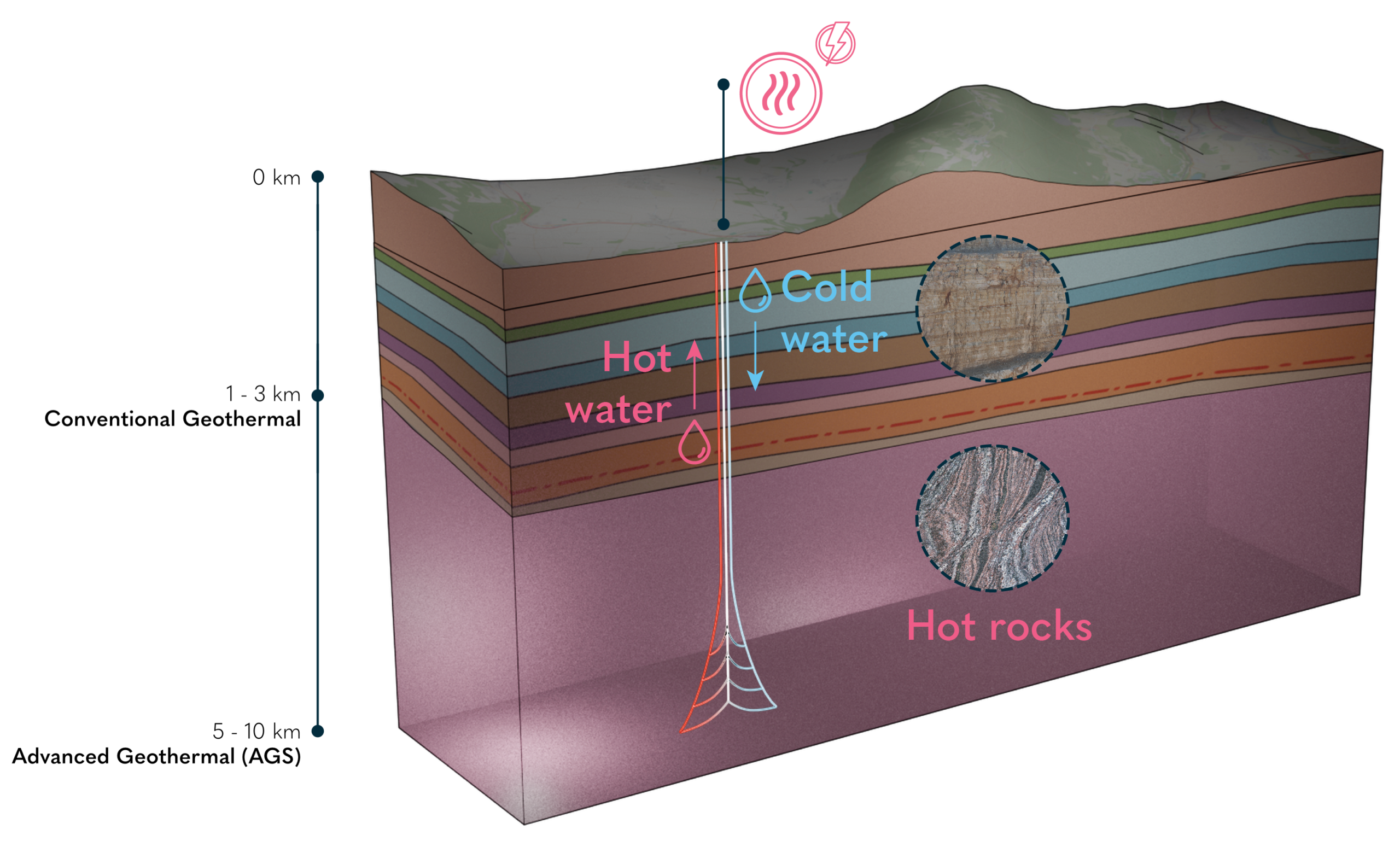
A closed-loop system engineered to recover heat from deep hot rock
Geothermal tremendous untapped reserves
Our planet has a sun inside
The heat is everywhere beneath our feet.
The challenge is accessing it safely and reliably!
Deep Geothermal Explained
The largest source of energy on Earth
From resource-dependent to engineered geothermal. AGS unlocks deep geothermal heat without relying on rare permeable reservoirs or fracturing hot rock.
GEOTHERMAL 1.0
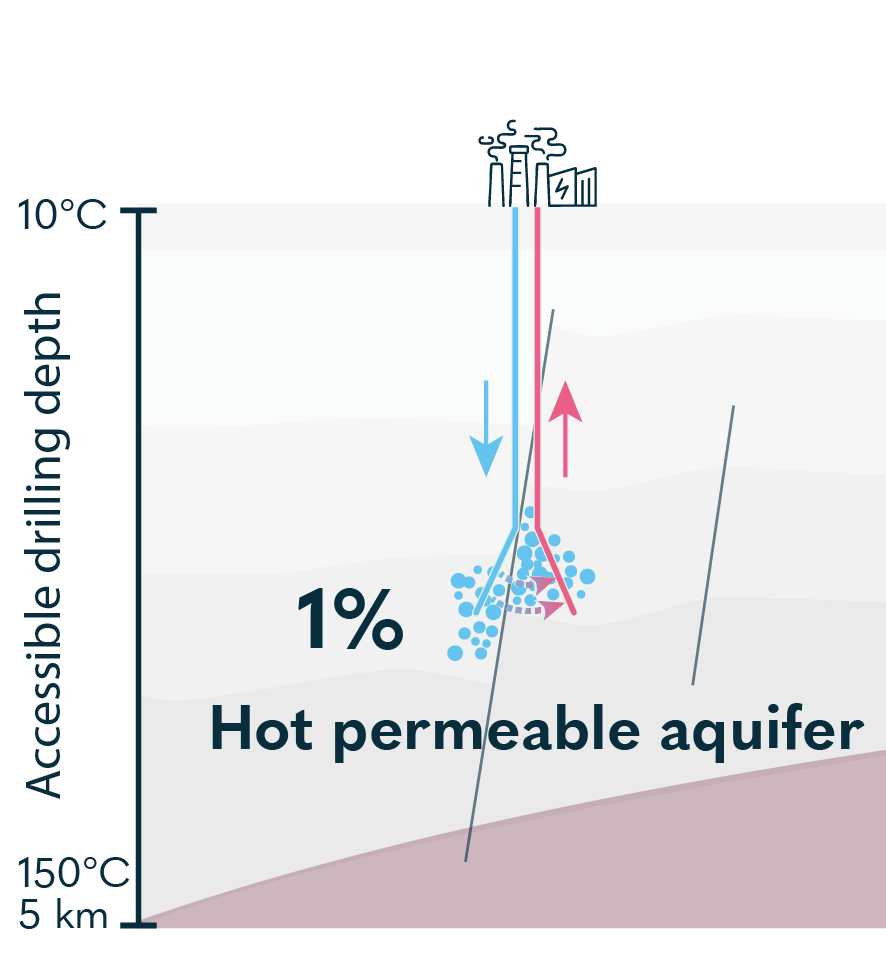
Conventional Hydrothermal
✕ Limited scalability
✕ Location dependant
✕ May induce seismicity
Recovers heat from rare (< 1%) hot permeable aquifers.
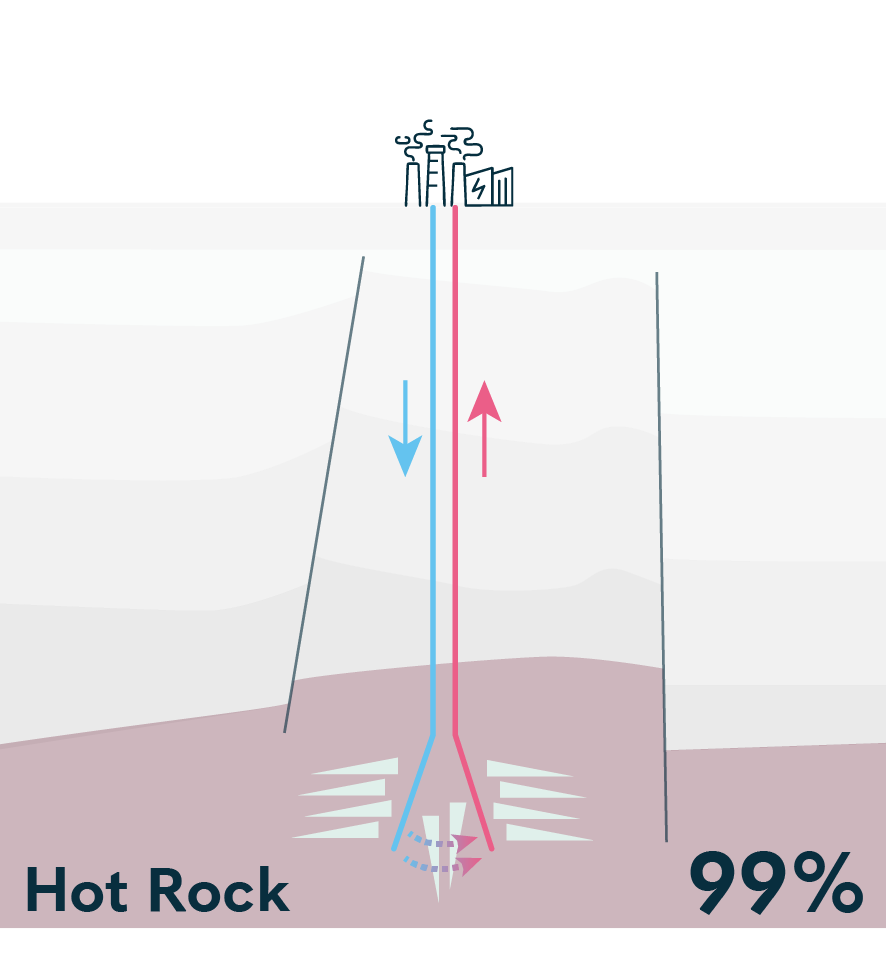
GEOTHERMAL 2.0
Enhanced Geothermal (EGS)
✓ Scalable
✕ Urban deployment constrained
✕ Risk of induced seismicity
Creates artificial reservoirs by fracturing hot rock, with risk of induced earthquakes.
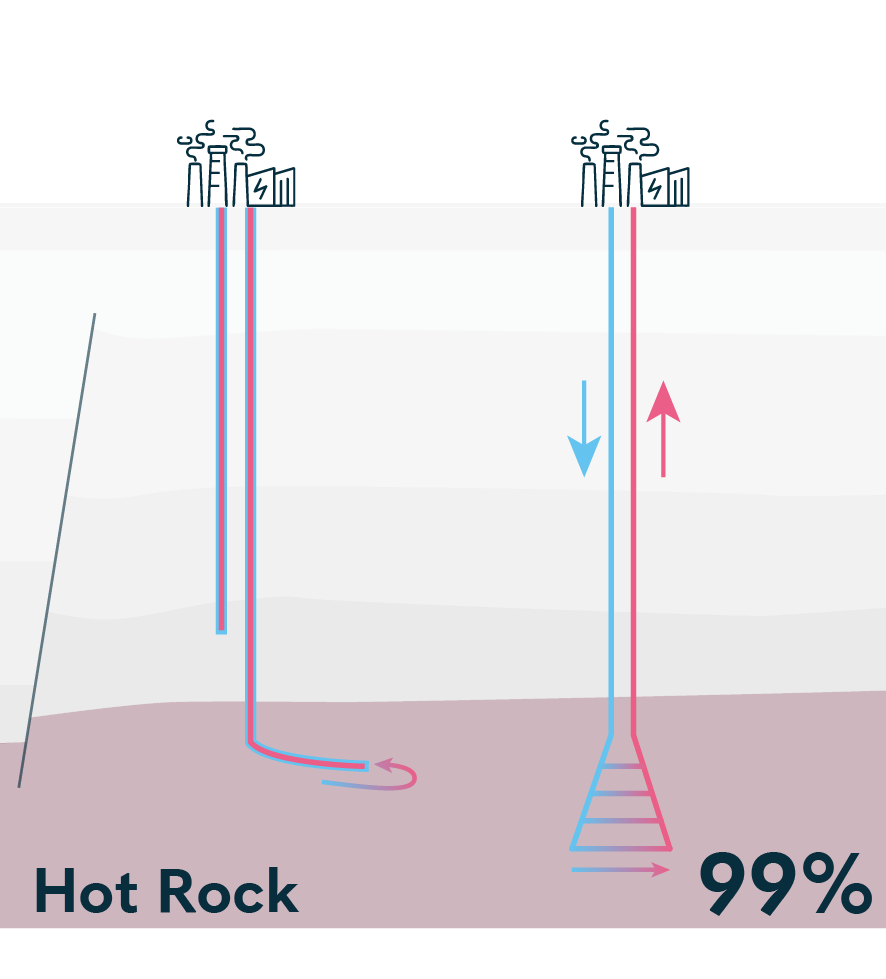
GEOTHERMAL 3.0
Advanced Geothermal (AGS)
✓ Scalable
✓ Widely deployable
✓ Neglectible risk of induced seismicity
Recovers heat passively through a closed-loop heat exchanger drilled into hot rock.

Geothermal 3.0
Key Benefits
AGS repurpose proven oil and gas drilling technologies to safely access the heat beneath our feet, opening the way to geothermal at scale.
Anywhere. Predictable. Tailored.
AGS tap into ubiquitous underground heat and rely on conductive heat transfer rather than reservoir properties. The result is predictable energy output and systems that can be dimensioned to match local demand.
Safe by nature
No fracking. No reservoir stimulation. By keeping the working fluid within a sealed loop, AGS eliminates the risk of induced seismicity, supporting social acceptance and deployment closer to where energy is needed.
NATURAL CIRCULATION, MINIMAL OPERATING COSTS
Once initiated, the working fluid circulates through the closed loop by natural thermosiphon, minimizing pumping requirements and operating energy consumption.
Built to last
No corrosive formation brines, minimal water use and a sealed, controlled working fluid environment. The result is durable energy infrastructure with reduced maintenance requirements and long-term operating reliability.
EAPOSYS AGS
Patented Incremental Design
Our modular closed-loop AGS is built for staged deployment.
Developed with leading drilling expertise, it combines proven oil & gas technologies with EAPOSYS patented innovations.
At its core, our service well enables the system to grow incrementally, from kick-starter to large-scale deployment.
HOW IT WORKS
1. Drill deep
Down to 3-5 km where ambient temperature exceeds 100°C
2. Connect wells
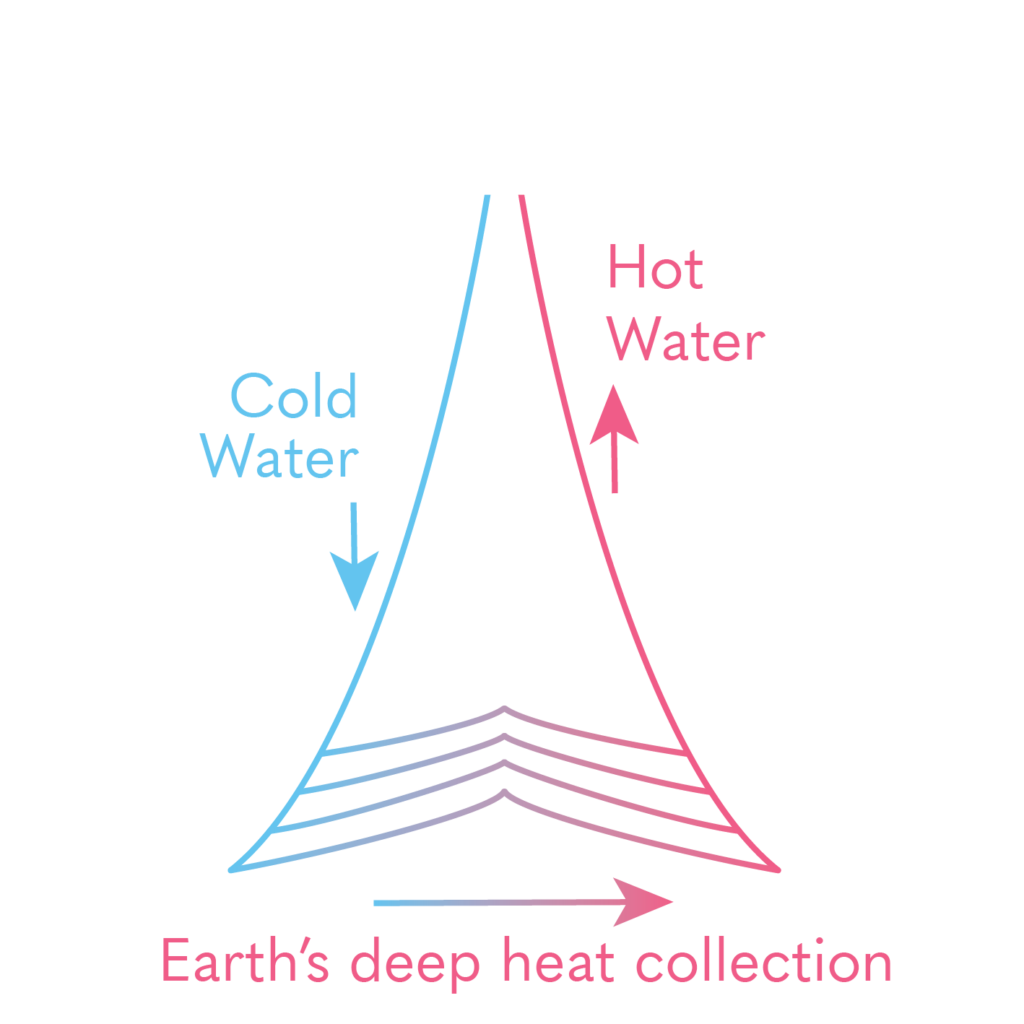
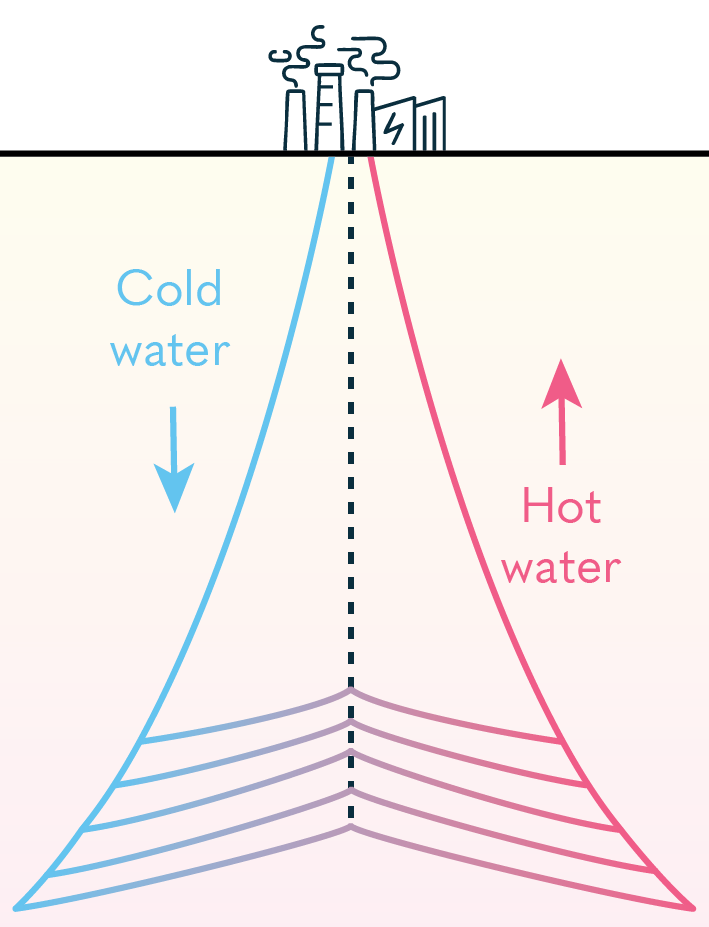
Create closed underground loops from the service well
3. Self-circulation (thermosiphon)
Cold water flows down, heats up, and circulate naturally, without pumping
4. Collect heat at surface
Heated water rises at the well head supplying industrial heat
Unique Selling Proposition
Single-rig drilling & early revenues
Our AGS architecture can be drilled from a single rig, reducing the cost and downtime associated with mobilizing a second rig, while also reducing the platform footprint and facilitating deployment closer to urban and industrial heat demand.
Its incremental design allows energy production to start as soon as the first heat-collection loop is completed, generating earlier revenues while additional loops are progressively added.
Incremental drilling from service well & simplified hydraulics
Our patented service well provides a single access point from which each heat-collection loop is drilled and completed individually, allowing the system to expand progressively, loop by loop.
Because each loop is developed independently, drilling does not require hydraulic control of the entire previously completed multilateral system, simplifying the drilling sequence and reducing the risk of unintended hydraulic communication.
Butterfly-shaped heat collection means no risk of thermal shortcut
Our central service well enables a butterfly deployment geometry that limits thermal interaction between incoming and returning flow paths.
By avoiding cross-flow configurations where cold inlet and hot outlet sections are closely stacked, our patented design eliminates the risk of thermal short-circuiting, maximizes exposure to undisturbed hot rock and supports efficient, sustained heat recovery.
Development Path
Validate · Learn · Scale
We start with flagship heat installation(s), realistically sized for immediate deployment and directly aligned with an existing market need. Over the next five years, our goal is to validate real-world performance and establish bankable AGS references. We learn with every deployment, building the expertise to confidently drill deeper, scale to larger systems and add baseload electricity generation in the next decade.
Kick-Starter
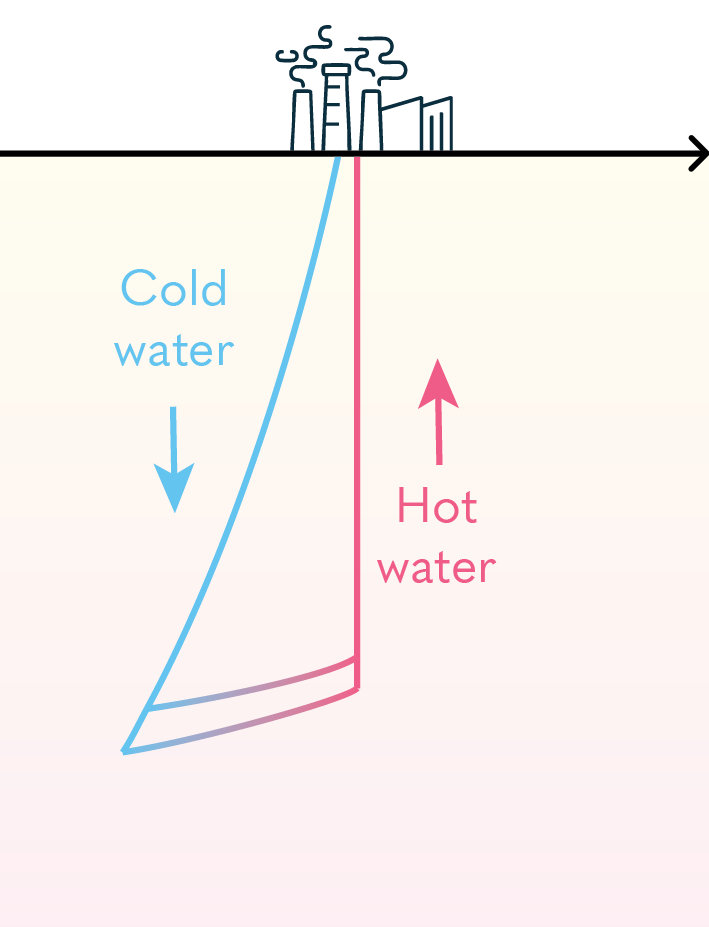
2 MWth ~ 10 GWh/y
Medium
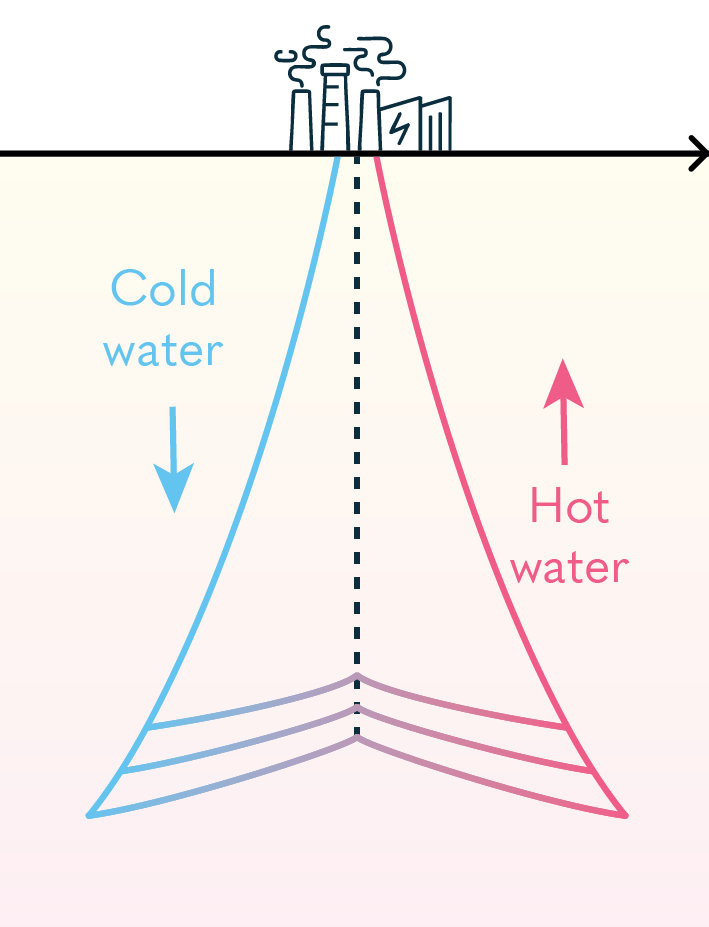
5 MWth ~ 25 GWh/y
LARGE
8 MWth ~ 50 GWh/y
Our systems target accessible, drillable depths of up to ~5 km. We consider a reference geothermal gradient of ~30°C/km (higher gradients would deliver higher temperatures and greater energy output).
Heat output can typically be adjusted from ~60°C to 90°C+, primarily by controlling the system flow rate. Higher flow rates maximize thermal output, while lower flow rates increase the delivery temperature, enabling cascaded heat uses and, at higher temperatures, additional power generation.
Natural thermosiphon is typically established at ~15–30 L/s, from smaller to larger systems, at deployment depths around 5 km and with individual lateral legs up to ~2 km. Natural circulation eliminates the parasitic power demand associated with circulation pumps, improving overall system efficiency.
From Geology to Predictable Energy Performance
EAPOSIM
Our AGS Simulation Software
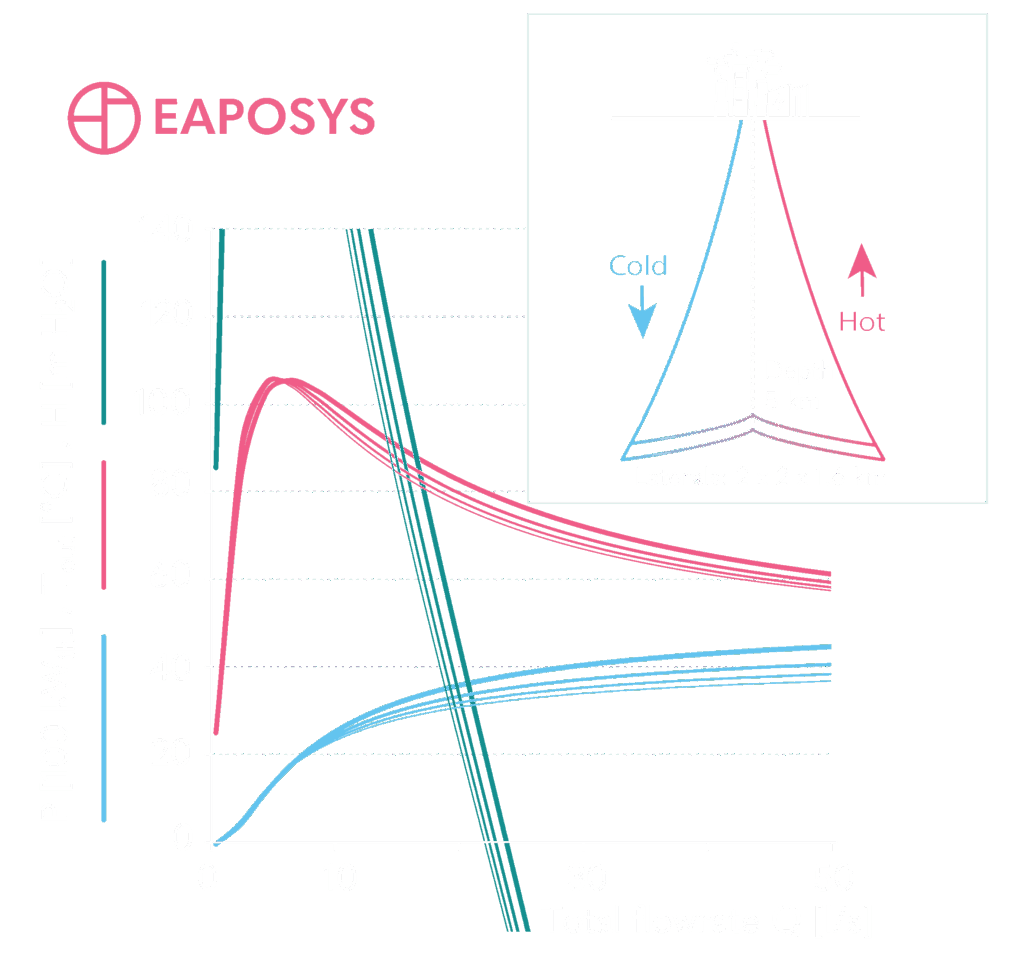
EAPOSIM is EAPOSYS’ engineering and simulation suite for the design, optimization and performance assessment of Advanced Geothermal Systems.
From site-specific geology and well design constraints to long-term thermal output and natural circulation, EAPOSIM enables our engineers to rapidly explore system configurations, understand the trade-offs that drive performance, and converge toward an optimized geothermal design before committing capital underground.
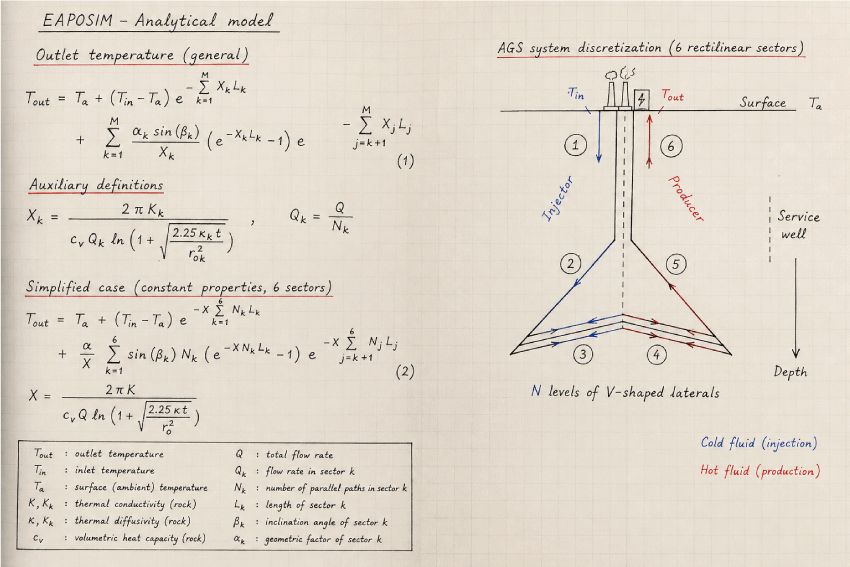
EAPOSIM is built around analytical calculation tools and models, providing near-instant results and enabling engineers to rapidly explore a large design space.
Unlike computationally intensive numerical simulations, configurations and operating scenarios can be tested at the click, making iterative design and optimization practical.
Our analytical models and calculations have been extensively benchmarked against high-resolution numerical simulations, with long-term outlet-temperature predictions typically providing sub-degree resolution in the reported validation cases.
EAPOSIM combines the speed of analytical modelling with the confidence of rigorous numerical validation.
EAPOSIM combines analytical thermal, hydraulic and geometric models into an integrated engineering toolset for the design and assessment of closed-loop geothermal systems.
Its analytical calculation module can model multiple wellbore sections along predefined polygonal geometries, incorporating the interaction between geology, well architecture, materials and operating conditions within a vertically linear geothermal gradient field.
Its analytical calculation module can model multiple wellbore sections along predefined polygonal geometries, incorporating the interaction between geology, well architecture, materials and operating conditions within a vertically linear geothermal gradient field.
Parameters include geothermal gradient, rock thermal properties, well depth and trajectory, lateral configuration, casing and insulation, injection temperature and flow rate.
Rather than evaluating a single predefined design, EAPOSIM enables our engineers to rapidly explore the design space.
Depth, lateral length, number of laterals, flow conditions and other technical parameters can be varied to assess their impact on outlet temperature, thermal power and circulation behavior over time.
Energy output can be calculated as a function of flow rate and injection temperature, providing results at a click and enabling the rapid development and comparison of different usage scenarios and their associated system configurations.